
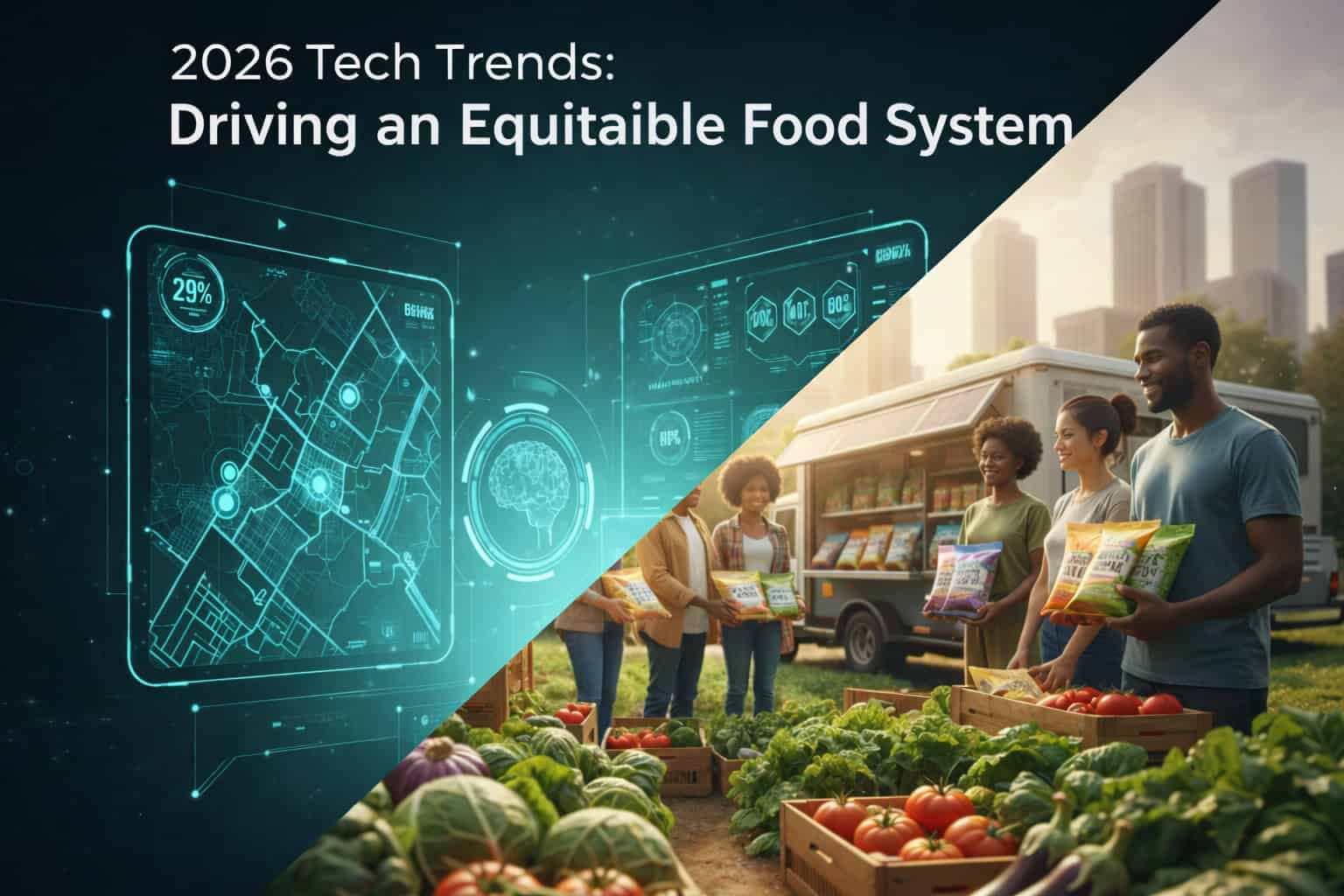
From Forecasts to Food Deserts
By 2026, the fight against food waste is an urgent dual mission: profit optimization and social equity. Driven by a national goal from the U.S. government (USDA, EPA, FDA) to cut food loss and waste by 50% by 2030 (USDA & EPA, 2024), the system is adopting integrated, technology-driven strategies to prevent waste and close the access gap in food deserts (areas with limited access to affordable, fresh food).
2026 Trends to Watch: The Digital Leap for Prevention
The key to preventing waste is the wide-scale adoption of Artificial Intelligence (AI) and national standardization efforts.
Clarified Date Labeling: Confusion over food date labels causes U.S. consumers to discard an estimated 3 billion pounds of food annually (ReFED / Harvard Law School, Feb 2025). The FDA continues to push for industry adoption of standardized terms like “Best if Used By” to reduce this unnecessary household waste.
AI and Dynamic Pricing: AI is the engine for loss reduction in retail. AI-powered dynamic pricing models automatically discount perishable goods nearing expiration. This model reduces grocery store food waste by 21% on average while also increasing profit margins (Source: Rady School of Management, July 2023).
Upstream AI Optimization: In manufacturing, AI enables predictive maintenance and demand forecasting. Facilities that embrace this technology report up to 45% improvements in Overall Equipment Effectiveness, drastically cutting production waste (Source: Unleashed Software, Nov 2025).
Recovery & Equity: Government Funding and Resource Re-purposing
When prevention falls short, federal programs and innovation ensure surplus and scraps serve a higher purpose, directly addressing social needs.
Upcycling Market Surge: The upcycled food market is projected to reach $70.71 billion in 2026 (Source: Research Nester, Dec 2025). Biotechnology is converting agricultural byproducts into shelf-stable, nutrient-dense meals for donation, transforming farm surplus into accessible nutrition (Source: The Guardian, Feb 2024).
Federal Funding for Food Rescue: Federal programs are key to scaling recovery. The USDA’s Community Food Projects Competitive Grants Program funds projects that directly improve access to nutrient-dense food in communities with low incomes, supporting the delivery of surplus food to vulnerable populations (Source: USDA NIFA, Dec 2025).
Decentralized Organics Processing: Federal funding is directed toward local solutions. The USDA Office of Urban Agriculture and Innovative Production provides grants to develop and implement composting programs, creating local, nutrient-rich soil to support urban farming initiatives in underserved areas (Source: USDA OUAIP, 2022 Funding Example).
Conclusion
Looking forward to 2026, the trends are clear: the fusion of digital intelligence and biological resourcefulness will define the food system. This technological leap enables businesses to maximize profit through precision prevention while simultaneously generating social good.
By integrating AI-driven forecasting and federally funded recovery programs, 2026 marks the year that food waste reduction cements its role as a fundamental strategy for achieving both sustainable business practices and true food equity across the nation.
By Vikram Mavalankar, O2I Volunteer