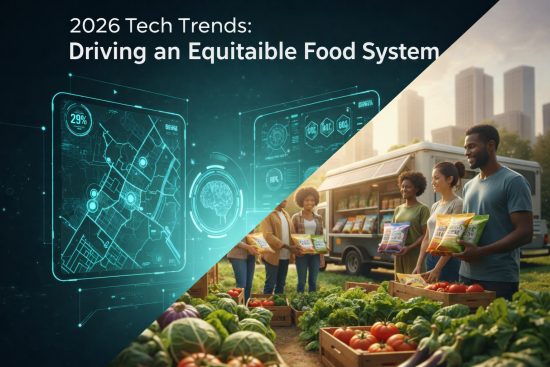
2026 Tech Trends That Will Drive an Equitable Food System

From Forecasts to Food Deserts

By 2026, the fight against food waste is an urgent dual mission: profit optimization and social equity. Driven by a national goal from the U.S. government (USDA, EPA, FDA) to cut food loss and waste by 50% by 2030 (USDA & EPA, 2024), the system is adopting integrated, technology-driven strategies to prevent waste and close the access gap in food deserts (areas with limited access to affordable, fresh food).

2026 Trends to Watch: The Digital Leap for Prevention

The key to preventing waste is the wide-scale adoption of Artificial Intelligence (AI) and national standardization efforts.

Clarified Date Labeling: Confusion over food date labels causes U.S. consumers to discard an estimated 3 billion pounds of food annually (ReFED / Harvard Law School, Feb 2025). The FDA continues to push for industry adoption of standardized terms like “Best if Used By” to reduce this unnecessary household waste.

AI and Dynamic Pricing: AI is the engine for loss reduction in retail. AI-powered dynamic pricing models automatically discount perishable goods nearing expiration. This model reduces grocery store food waste by 21% on average while also increasing profit margins (Source: Rady School of Management, July 2023).

Upstream AI Optimization: In manufacturing, AI enables predictive maintenance and demand forecasting. Facilities that embrace this technology report up to 45% improvements in Overall Equipment Effectiveness, drastically cutting production waste (Source: Unleashed Software, Nov 2025).

Recovery & Equity: Government Funding and Resource Re-purposing

When prevention falls short, federal programs and innovation ensure surplus and scraps serve a higher purpose, directly addressing social needs.

Upcycling Market Surge: The upcycled food market is projected to reach $70.71 billion in 2026 (Source: Research Nester, Dec 2025). Biotechnology is converting agricultural byproducts into shelf-stable, nutrient-dense meals for donation, transforming farm surplus into accessible nutrition (Source: The Guardian, Feb 2024).

Federal Funding for Food Rescue: Federal programs are key to scaling recovery. The USDA’s Community Food Projects Competitive Grants Program funds projects that directly improve access to nutrient-dense food in communities with low incomes, supporting the delivery of surplus food to vulnerable populations (Source: USDA NIFA, Dec 2025).

Decentralized Organics Processing: Federal funding is directed toward local solutions. The USDA Office of Urban Agriculture and Innovative Production provides grants to develop and implement composting programs, creating local, nutrient-rich soil to support urban farming initiatives in underserved areas (Source: USDA OUAIP, 2022 Funding Example).

Conclusion

Looking forward to 2026, the trends are clear: the fusion of digital intelligence and biological resourcefulness will define the food system. This technological leap enables businesses to maximize profit through precision prevention while simultaneously generating social good.

By integrating AI-driven forecasting and federally funded recovery programs, 2026 marks the year that food waste reduction cements its role as a fundamental strategy for achieving both sustainable business practices and true food equity across the nation.

By Vikram Mavalankar, O2I Volunteer


$444B Fix: The California Blueprint to End U.S. Food Waste

The United States wastes 38% of its total food supply every year, resulting in an economic drain exceeding $444 billion, approximately 2% of US GDP. The U.S. still has a long way to go to meet the 2030 goal set by the EPA for reducing 50% of food waste by 2030. To tackle this crisis, the solution must move beyond simple recovery and focus on prevention at the source.

Food Waste in California

Californians send 2.5 billion meals worth of still-fresh, unsold food to landfills each year, even though 1 in 5 Californians do not have enough to eat. These households often must choose between eating and basic needs like housing or medical bills.

To reduce food waste and address food insecurity, surplus food that is still safe for people to eat will be donated to food banks, soup kitchens, and other food recovery organizations and services to help feed Californians in need.

This will cut waste sent to landfills and lower methane climate pollution from organic waste rotting in landfills.

  • 2.5 billion meals worth of potentially donatable food is landfilled a year.
  • This could help feed millions of the 1 in 5 Californians without enough to eat.

The Good News:

California communities have expanded programs to send still-fresh, unsold food from large food businesses to Californians in need.

  • About 700 million unsold meals went to Californians in need since food recovery rulesstarted in 2022.

To support non-profit organizations and local efforts, CalRecycle’s grant funds projects that prevent food waste or rescue edible food that would be landfilled to help Californians in need.

CalRecycle’s SB 1383

California is tackling food waste through statewide mandates (SB 1383) requiring cities to implement organic waste collection (composting, renewable fuel) and edible food recovery programs, aiming for 75% reduction in landfill disposal by 2025. This involves mandatory food scraps collection for residents, businesses, and large events, plus boosting donation of surplus food to help reduce methane emissions, support local food systems, and create compost. Individuals can help by planning meals, using leftovers, understanding date labels, and participating in local collection programs.  SB 1383 has established guidelines and recommendations to implement a state-wide plan which includes a framework on food recovery and waste management.

CalRecycle’s SB 1383 Edible Food Recovery Goals

SB 1383 requires the state, by 2025, to recover 20% of edible food for human consumption that would otherwise be disposed. This is a statewide goal that California must collectively achieve. It is not a goal for individual jurisdictions to achieve. To achieve this statewide goal, SB 1383’s regulations require commercial edible food generators donate the maximum amount of their edible food that would otherwise be disposed. The regulations also require jurisdictions to implement edible food recovery programs to help increase food recovery throughout the state.

Projects awarded since 2018 have resulted in (data as of September 2025):

  • 260 million meals
  • 443 local jobs
  • 312 million pounds of food kept out of landfills to date
  • GHG (Greenhouse Gas) reductions equal to 68,692 cars off the road (294,492 MTCO2e less to date)

Together, we can transform California’s approach to food, turning what was once waste into a sustainable resource that protects our environment and supports our climate goals.

By Vikram Mavalankar, O2I Volunteer


Roadmap 2030: How to Prevent Food Waste, Recover, and Recycle?

Food waste is a huge problem with local, state, and national impacts, representing one of the most immediate opportunities to fight climate change and improve food security.

The Scope, Goals, and Climate Impact

The scale of food waste is staggering. Nationally, 30-40% of the food supply is never eaten (Source: USDA). This massive waste is a primary driver of methane, a powerful greenhouse gas (GHG) that is over 80 times more potent than carbon dioxide in the short term, with an estimated 58% of fugitive landfill methane coming from decaying food (Source: US EPA).

In California, where an estimated 5-6 million tons of food are thrown away annually (Source: CalRecycle via CDFA), the statewide goal is ambitious: to achieve a 75% reduction in organic waste disposal by 2025 (Source: CalRecycle). Our national goal, shared by the EPA and USDA, is a 50% reduction in food loss and waste by 2030 (Source: USDA/EPA).

In the San Francisco Bay Area, the waste challenge is also one of equity. Nearly one-in-three people in Silicon Valley struggle with food insecurity (Source: Joint Venture Silicon Valley), and 1 in 4 residents in San Francisco are food-insecure (Source: ExtraFood). Consequently, cities in Santa Clara County (San Jose, Santa Clara, Milpitas) are focused on the local goal of rescuing at least 20% of currently disposed edible food for human consumption by 2025 (Source: City of San José/SB 1383).

Recovery and Community Action

Bay Area communities are leveraging prevention, recovery, and recycling. Nonprofits and recovery services rely on diverse volunteers—from kids to youth and local communities—to collect and distribute food. San Francisco’s city-supported programs have recovered nearly 9 million pounds of food, resulting in 8 million meals served since 2019 (Source: SF.gov). Local government institutions, like the Santa Clara County Food Recovery Program, are key stakeholders, enforcing mandates on commercial food generators across cities to divert organic waste from landfills and cut methane emissions.

Funding the Future & 2026-2030 Roadmap

Local grants are vital for program expansion and capacity building. Agencies like CalRecycle and the SF Environment Department offer competitive grants to nonprofits and municipalities for equipment, infrastructure, and prevention programs (Source: CalRecycle & SF Environment).

The 2026-2030 Roadmap outlines the steps to scale these solutions:

  • 2026 (Infrastructure): Focus on fully implementing mandated edible food recovery and organics collection infrastructure, often supported by securing state and local grant funding for essential assets like new refrigeration units.
  • 2027 (Prevention): Launch major public education campaigns targeting household food waste, aiming for a measurable reduction in residential waste generation.
  • 2028-2029 (Capacity): Expand nonprofit recovery by at least 25% (pounds recovered) and implement robust contamination enforcement in organics collection, with support from municipal stakeholders.
  • 2030 (Target): Successfully achieve the national goal of a 50% food waste reduction across the entire supply chain.

By Vikram Mavalankar, O2I Volunteer


The $7 for $1 payoff: A business case for reducing food waste

The Core Challenge

Our food system is in crisis. In the U.S., nearly 40% of all food produced is wasted – a crisis that is costing us twice: in dollars and in climate stability.

The United States aims to reduce food loss and waste by 50% by the year 2030. This goal is part of a broader initiative led by the U.S. Environmental Protection Agency (EPA) and the U.S. Department of Agriculture (USDA).

Climate Cost

Financially, this waste represents an annual economic drain of over $162 Billion [USDA]. And the environmental cost is even higher: the carbon footprint of wasted food is equivalent to the annual emissions of 37 million cars.

The Solution: Prevent, Recover, Recycle

Prevent – The Financial Mandate

The greatest return is always realized when waste is stopped at the source.

The incentive is simple:

  • An average financial return of $7 for every $1 invested [Champions 12.3 Source].
  • This report analyzed data of pre-consumer food waste from 114 restaurant sites, located across 12 countries, and calculated the following results:
  • The average benefit-cost ratio for food waste reduction was 7:1 over 3 years
    • Within the 1st year of implementing a food waste–reduction program, 76% of the sites had recouped their investment.
    • Within 2 years of implementing the program, 89% of the sites had recouped their investment.
  • By reducing food waste, the average site saved more than two cents on every dollar of cost of goods sold (COGS).
  • There appears to be no clear correlation between benefit-cost ratios and a site’s market segment or geography.
  • Key strategies for achieving food waste reduction were to measure food waste, engage staff, reduce food overproduction, rethink inventory and purchasing practices, and repurpose excess food.
  • At the consumer level, it is important to focus on behavior:
    • We must educate families to avoid the $1,500 a year they currently lose and empower young people to see through the confusion of date labels that trick 80% of consumers into wasting perfectly edible food.
    • Food waste prevention starts in the kitchen whether at home, school or the office.

Recover – The Social Mandate

When food waste cannot be prevented, it must be recovered.

The food we lose nationally could provide 130 billion meals, that equates to 3 meals per day for US families for an entire year. We inform businesses that the Bill Emerson Good Samaritan Act provides the liability protection they need to confidently donate their surplus [Federal Law/USDA Source].

And we must start with our children. Simple advocacy, like adopting the 20-minute lunch rule, is proven to cut cafeteria waste by up to 40%, ensuring more food nourishes students, not landfills.

Recycle – The Climate Mandate

When food decomposes in a landfill, it generates Methane, a super-pollutant that is 80 times more potent than over the short term. This is urgent because food waste is responsible for 58% of the fugitive methane emissions from municipal landfills.

Despite this urgency, only a tiny 4% of food waste is currently composted. Our goal here is to close this gap—scaling composting infrastructure to mitigate the climate warming that methane drives.

The Final Mandate and Call to Action

The data is indisputable. From the financial promise of the $7 return to the critical need to curb methane, food waste reduction is the most effective investment we can make today.

The U.S. government has set the goal: a 50% reduction by 2030.

This is an achievable milestone built on smart planning, effective donation, and responsible recycling.

By Vikram Mavalankar, O2I Volunteer


How can we reduce Food Waste in our Community?

Why does it take a village to raise a child? Because a critical aspect of human development is our environment. Not just the people in our environment, but the institutions they create and run. It’s important that these establishments demonstrate the behaviors we are expected to display in society. For example, seeing compost bins in restaurants encouraged me to get my own for my home. Societal norms are frequently reinforced or even started by our community organizations and companies. So, if we want to reduce food waste, we need our village (or community) to set the example.

Here are some impactful ways owners of our community establishments can reinforce the importance of reducing food waste:

  • “Skip a Side” initiative. Quite often combo meals come with additional food that’s undesired (I’m looking at you coleslaw). When substituting for something else isn’t an option, people will typically just take what is given and not eat it. If encouraged, it’s likely people would skip a side, even without a price adjustment. This can be communicated with menu notes or posters in restaurants that encourage patrons to ask that a side be excluded if they don’t plan to eat it (similar to hotels asking to hang up towels that will be reused). As a limited promotion for the initiative, owners can provide coupons to those who participate.
  • Food surveys and analytics. Periodically ask the consumer what they think of the current food and/or monitor consumption. Customer surveys can at times be noisy, but you can get a sense of what’s most liked/disliked. This information can help reduce food that stays in a kitchen unordered or on a plate uneaten. This practice doesn’t only apply to restaurants – schools, churches, or any community center that provides food can benefit from knowing if people want what they’re giving (even if it’s free).
  • Reduce over-service. For serving lines, encourage food workers to start with the minimum and add more upon request. For paying establishments, there may be concerns of coming across as ‘cheap’. In this event, posted literature letting the customer know why your team is taking this approach can go a long way.
  • Spread the Word. Recycling, due to great PR, went from non-existent to being a standard practice around the world. Until food waste reduction can capture that type of representation, community leaders can trailblaze this effort by displaying infographics in their establishments. For example, share ways the organization reduces food waste. This would not only be good PR for the initiative, but for your institution as well.

For help on how you can implement these ideas or others, please contact Outside2Inside to support your food waste reduction journey.

By Felicia Yoakum, O2I Volunteer


Trash Talk: The Multimillion-Dollar Price Tag of Food Waste in Cities

Amidst every city’s hustle, glitz, and glamor lies a costly secret hidden in plain sight- food waste.  According to the U.S. Department of Agriculture (USDA), food waste accounts for 30-40 percent of the nation’s food supply. To put that into perspective, this amounted to an astonishing 133 billion pounds of food, valued at nearly $161 billion, lost in 2010 alone.  In relation to food waste costs within urban settings, dealing with issues ranging from spoilage to transportation and food processing has both indirect and direct impacts on a community’s economy. The costs associated with food waste in urban settings are both direct and indirect when it comes to spoilage, transportation, and the processing of food.

Food loss is a multifaceted issue rooted in various causes, encompassing distinct forms of loss, such as spoilage, that manifest throughout the entire production and supply chain. Spanning from the point of harvest to the retail stage, food loss can materialize due to challenges encountered during processes like drying, milling, transportation, and processing, which make food susceptible to damage inflicted by insects, rodents, birds, molds, and bacteria. Retail food loss may stem from equipment malfunctions, such as faulty cold storage facilities, excessive ordering practices, and the discarding of imperfect produce. Additionally, consumers play a role in contributing to food loss when they purchase or cook more than necessary and opt to dispose of surplus items.

Similarly, when we waste food, we are discarding edible resources and squandering the significant energy investments that go into its transportation. According to a study conducted by Columbia University, the journey from farms to consumers’ homes accounts for a significant portion of the overall energy consumption in the United States, nearly 10 percent of the nation’s energy budget. This staggering statistic underscores the interconnectedness of food production and energy consumption. Every scrap that ends up in the trash reflects a missed opportunity to nourish someone and embodies the vast amounts of fossil fuels, electricity, and human effort expended in cultivating, harvesting, processing, packaging, and delivering that food to our tables. Therefore, minimizing food waste isn’t just about reducing the environmental impact; it’s also a crucial step in conserving energy resources and mitigating the broader ecological footprint of our food system.

In addition, processing errors at the retail level significantly contribute to food loss, impacting both businesses and the environment. One error can be found in equipment malfunctions, such as when refrigeration units fail in cold storage facilities, causing perishable goods to spoil and resulting in significant food wastage. Moreover, over-ordering products in anticipation of customer demand can lead to excess inventory, which remains unused and ultimately discarded. Another contributing factor is the rejection of imperfect produce; retailers often discard fruits and vegetables that do not meet strict cosmetic standards. According to Columbia University, this facet of food waste constitutes nearly 40% of unconsumed food. Collectively, these practices underscore the pressing issue of food loss and emphasize the crucial need for the implementation of sustainable and efficient strategies within the retail sector to address this problem.

While the allure of cities is undeniable, behind the scenes, millions of dollars are silently slipping through the cracks due to food waste. To combat this, we must adopt a holistic approach. Educating consumers about responsible purchasing and portion control, encouraging retailers to revise strict cosmetic standards, and investing in better storage and transportation systems are essential. Additionally, supporting food recovery programs and embracing technology to track and manage inventory can make a substantial impact. By working together, we can transform our urban landscapes and build a more sustainable future.

By Maha Qureshi
O2I Volunteer


Zero Waste Kitchens: Sustainable Practices for Food Waste

It is disturbing how much food is wasted worldwide. 1.3 billion tons of food are wasted annually, according to the Food and Agriculture Organization of the United Nations (FAO). Along with wasting precious resources, this causes the release of methane gas from decaying food, which worsens climate change. The World Wildlife Fund (WWF) estimates that the financial impact of food waste is about $1 trillion annually, which is cause for concern. Zero waste kitchens are designed to produce as little trash as possible using the concepts of reducing, reusing, and recycling. Individuals may dramatically reduce their carbon footprint and help create a more sustainable future by implementing these practices.

 1. Mindful Meal Planning

Conscious meal planning is a key component of zero waste kitchens. To avoid overspending, the Natural Resources Defense Council (NRDC) stresses the value of making shopping lists based on actual needs. This method not only saves money but also lessens food waste. Because less resources are used in the production, transportation, and disposal of food when there is less food waste. Households can also save money by forgoing pointless purchases and maximizing the value of the food they do purchase.

 2. Recycling and Composting

Diverting food scraps from landfills is a powerful technique to use composting to treat organic waste. Composting improves soil, lowers methane emissions, and closes the nutrient loop, according to the United States Environmental Protection Agency (EPA). During the composting process, organic wastes such as food scraps, yard debris, and other biodegradable items break down. Compost that is rich in nutrients is created when these materials decompose. The soil’s structure, ability to retain water, and nutrient content can all be enhanced by adding this compost to it. Compost’s organic material improves soil fertility and encourages the development of helpful bacteria that support plant growth.

 3. Leftovers and Creative Cooking

Kitchens that produce zero waste encourage inventive cooking to make the most of leftovers. Anne-Marie Bonneau, a cookbook author and proponent of zero waste, encourages “planned-overs,” where extra food is cooked with the intention of using it in later meals. Cooking leftovers reduces the likelihood that they will go to waste. It motivates people to plan ahead and find inventive ways to use leftover food, avoiding it from going to waste. The sustainable development and responsible consumption objectives of the zero-waste movement are supported by this strategy.

 4. Food Preserving Techniques

The shelf life of ingredients can be increased by using food preservation procedures like canning, pickling, and freezing. The Zero Waste Chef, Anne-Marie Bonneau, underscores the importance of these techniques in reducing food waste and promoting a circular economy. Communities can start composting initiatives and instruct locals on how to get involved. Businesses can use methods like giving extra food to those in need or recycling scraps into new goods to reduce food waste in their operations. Governments can also contribute by putting in place laws that promote sustainable lifestyles and forbid excessive consumption.

Adopting zero waste practices in our kitchens is not just a moral decision in the quest for a sustainable future, but also a sensible one. Through thoughtful meal planning, appropriate storage, composting, and other methods, people can lessen food waste and lessen the demand on the world’s resources. We move closer to living an environmentally conscious lifestyle as we adopt the zero waste kitchen principles, benefiting both the present and the next generation. It’s important to remember that even small changes in the kitchen can lead to significant global impact.

By Gaura Jha
Student Volunteer @ O2I


Food Waste Auditing: How to drastically reduce food waste within our public educational institutions

According to FeedingAmerica.org, each year, Americans throw away up to 119 billion pounds of food. Coincidently, food waste reduction has recently become a major part of American’s lives now, and schools have a big part to play in developing a sustainable food system. Food waste audits is a practical strategy for reducing food waste in educational institutions – it is a methodical procedure that involves monitoring, measuring, and evaluating food waste in order to pinpoint areas that may be improved upon and put waste-reduction plans into action.

First and foremost, while performing food waste audits in schools, it’s crucial to rely on reliable sources and organizations. Guidelines and tools for performing food waste audits in schools are provided by reputable organizations including the United States Department of Agriculture (USDA), Environmental Protection Agency (EPA), and National tools Defense Council (NRDC).

Setting up a baseline is the first stage in performing a food waste audit. This entails counting the amount of food that is wasted in the canteen or other eating establishments. Clear instructions on how to measure and manage food waste are provided by trustworthy sources like the EPA’s “Food Recovery Hierarchy”. Schools may make sure that their findings are reliable and comparable to local or national statistics by employing standardized procedures.

The classification of the many food waste kinds produced is a crucial component of food waste audits. Food waste may be divided into categories such as plate waste, spoilage, preparation waste, and leftovers to achieve this. Consistency and dependability in the audit process are guaranteed by using recognized definitions and categories from reliable sources, such as the USDA’s “School Food Waste Assessment Guide”.

After the food waste has been categorized, it’s critical to conduct an analysis of the information to spot trends and patterns. Schools may use this to better understand the causes of food waste production and pinpoint areas for development. NRDC’s “Wasted: How America Is Losing Up to 40% of Its Food from Farm to Fork to Landfill” and other reputable sources offer information on the main reasons why food loss occurs in schools, including overproduction, poor meal planning, and student food preferences.

Schools can create initiatives to cut back on food waste based on the auditor’s results. Implementing portion control measures, enhancing meal preparation and planning, supporting food recovery programs, and informing students and staff about the value of preventing food waste are some examples of these techniques. To make sure that the plans are supported by data and efficient at minimizing food waste, it’s crucial to consult reputable institutions and sources while establishing them. In order to maintain efforts to reduce food waste, monitoring and analyzing the success of the solutions put into practice is essential. The “Food Recovery Hierarchy” by the EPA is one trustworthy resource that offers advice on how to monitor and assess development over time. Schools can identify accomplishments and areas for development by tracking and analyzing the results of the initiatives, then making modifications as necessary.

As a result, food waste auditing is a useful tool for schools to recognize and manage the problem of food waste. Schools may make sure that their food waste audits are founded on correct information and best practices by relying on trustworthy sources and institutions. Schools may establish research-based initiatives to minimize food loss and build a more sustainable food system in their communities by recording, measuring, and evaluating food waste. Schools may reduce food waste by continually improving their efforts via monitoring and assessment, which will ultimately help create a more sustainable future.

References:

  1. https://www.epa.gov/sites/default/files/2017-12/documents/guide_to_conducting_student_food_waste_audit_-_nov_20_2017.pdf
  2. https://www.usda.gov/sites/default/files/documents/Student_Food_Waste_Audit_FINAL_4-6-2017.pdf
  3. https://www.nrdc.org/sites/default/files/wasted-food-IP.pdf
  4. https://www.epa.gov/sustainable-management-food/food-recovery-hierarchy

By Gaura Jha
Student Volunteer @ O2I


Improving Corporate Awareness of Food Waste – A UC Berkeley Students Experience!

Food, Equity, Entrepreneurship, & Development (FEED) is a food justice consulting student organization at UC Berkeley. In Fall 2019, we worked with Outside2Inside to generate innovative solutions to food waste on the UC Berkeley campus through a food waste education program. Our food waste education program was created to increase awareness of food waste among UC Berkeley students. We are planning to expand this into a program called Corporate Consciousness, which will provide food waste reduction strategies to corporations in the Bay Area.

At the beginning of the semester, we conducted outreach in the Bay Area, contacting over 25 companies that create food waste. After seeking partnerships, we conducted a thorough research analysis of the primary sources of food waste in corporations and innovative solutions these companies can take to address their food waste. This research informed the content of both our UC Berkeley education programs and our Corporate Consciousness program. In our research, we focused on the financial costs of food waste because we felt that corporates would be most invested in a program that could provide monetary benefits to their business. We found that, on average, a company can generate a financial return of $14 for every $1 spent on food waste reduction strategies in place of land-filling waste. We incorporated powerful information like this into our Corporate Consciousness program in order to show the extent to which food waste reduction strategies can benefit corporations.

While we continued to develop the Corporate Consciousness program, we implemented our food waste education pilot program in a UC Berkeley agricultural ecology class of around 40 students. We collected feedback from the students in order to understand what aspects of the program were more engaging and applicable. We then incorporated this feedback into our programs as we continued to design our future Corporate Consciousness program and UC Berkeley food waste awareness initiatives.

The Corporate Consciousness program aims to educate companies on the food waste that occurs at every stage of the supply chain in their business model and specific strategies that would reduce waste at each of these stages. For example, a corporate whose food waste primarily occurs at the preparation stage can add daily specials to surplus menu items to sell more of the food that would normally go to waste or take steps to incorporate a “nose-to-tail” approach — incorporating typically discarded but still edible parts of the produce such as the peel or stem. We included compelling data on the financial benefits of reducing food waste in a corporate and how pursuing more sustainable food practices in the business can boost corporate responsibility and public visibility within the community.

After we developed the Corporate Consciousness program, we developed a Volunteer Training curriculum that will allow us to bring Corporate Consciousness to scale by recruiting volunteers to effectively carry out the program as we develop partnerships with various corporations. The FEED team especially enjoyed using their creativity to design an effective program that will make a significant impact on the way companies approach food waste. We cultivated skills that we will carry with them into their careers, such as professional networking during the outreach period, effective communication and public speaking during our food waste awareness presentation, and program development at every stage of the project. We loved working with the amazing Outside2Inside team and collaborating with individuals who are as passionate as we are about changing the food system and making a positive impact on the lives of those within our community and beyond.


How Community Gardens reduce Food Waste?

The journey a vegetable takes from being planted on the farm to the grocery store can be long and complicated. First off, not all vegetables meet the standards to make the trip. Then, the vegetables that do get shipped face a variety of challenges.

The biggest waste happens when the vegetables are harvested and being prepared for shipping. Grocery stores only purchase vegetables and fruits that look good. There are no exceptions made for oddly shaped vegetables and these get discarded or set aside as livestock feed. In a community garden, all the produce is used. Even the weird-looking vegetables, the too-small carrots, the lopsided beets, the slightly bug-eaten cabbage. These are still perfectly good to eat even if they don’t look perfect.

The process of shipping fruits and vegetables thousands of miles from the farm to the grocery store is another area where lots of waste happens. The vegetables may rot on the long drive or show up in less than ideal conditions and get discarded before they make it to the shelf. Community gardens eliminate the whole transport issue because, of course, the gardens are local. They aren’t going to sit in a tractor-trailer on the highway spoiling and losing value. Freshly picked vegetables are always best taste-wise and nutritionally. The less a vegetable has to travel, the less likely it will become waste.

Additionally, community gardens can tailor what they grow to suit the specific desires of the community. If the gardens are growing what the local people want, then it will be eaten and not wasted. Community gardens thus are an excellent resource and strategy for reducing food waste.